Best Vinyl Flooring for Hospitals, Schools & Offices
- 1
Quick Answer
The best commercial vinyl flooring depends on hygiene requirements, traffic level, wear resistance, safety, and design.
| Application | Recommended Flooring | Main Benefit |
|---|---|---|
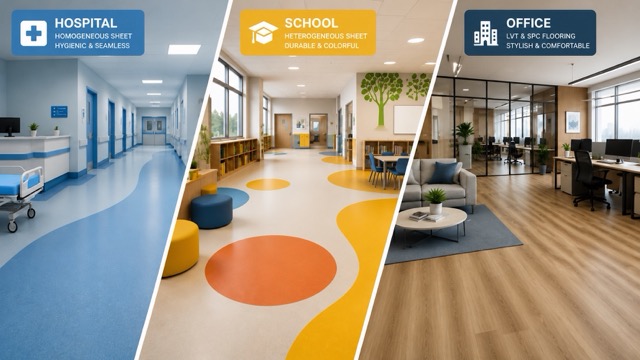
| Hospitals and clean areas | Homogeneous or heterogeneous PVC sheet flooring | Hygienic installation with heat-welded seams |
| Operating rooms and anti-static areas | ESD PVC sheet flooring | Controls static electricity |
| Schools and busy corridors | Heavy-duty homogeneous or heterogeneous sheet vinyl | High strength and wear resistance |
| Offices | LVT, SPC, or heterogeneous vinyl flooring | Modern design and easy maintenance |
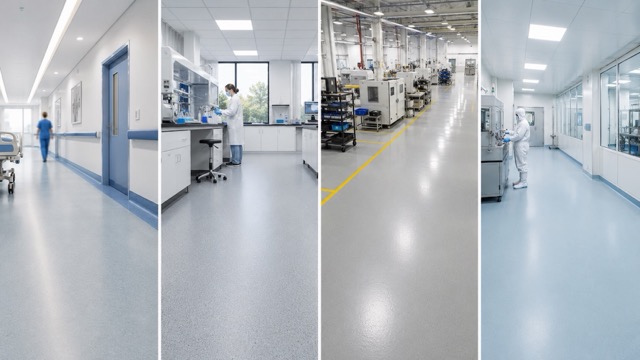
For hospitals and other areas requiring a high level of cleanliness, PVC sheet flooring is normally preferred. It is supplied in large rolls and installed with heat-welded seams, creating a continuous surface with very few joints. This reduces places where dust, dirt, moisture, and contaminants may collect.
Best Vinyl Flooring for Hospitals
The best flooring for most hospital areas is homogeneous or heterogeneous PVC sheet flooring.
Hospitals, clinics, treatment rooms, laboratories, and other clean environments need floors that are easy to clean and disinfect. Sheet flooring covers large areas with fewer joints than vinyl tiles or planks. After heat welding, the finished floor forms a continuous surface that is more hygienic and easier to maintain.
PVC sheet flooring can also be installed with coved skirting to create a smooth transition between the floor and wall. This reduces hard-to-clean corners and helps improve the overall hygiene performance of the room.
Recommended Flooring for Different Hospital Areas
| Hospital Area | Recommended Flooring |
|---|---|
| Corridors | Heavy-duty homogeneous or heterogeneous PVC sheet flooring |
| Patient rooms | Heterogeneous PVC sheet flooring |
| Treatment rooms | Homogeneous or heterogeneous PVC sheet flooring |
| Operating rooms | ESD, conductive, or static-dissipative PVC sheet flooring |
| Laboratories | Conductive or static-dissipative PVC sheet flooring |
| Waiting areas | Heterogeneous sheet vinyl or commercial LVT |
Operating rooms, laboratories, and some diagnostic areas may have anti-static requirements. These spaces should use certified ESD, conductive, or static-dissipative PVC sheet flooring according to the electrical resistance and technical standards required by the project.
Best Vinyl Flooring for Schools
Schools need flooring that can withstand constant foot traffic, furniture movement, daily cleaning, and impact.
For classrooms, corridors, cafeterias, libraries, and public areas, heavy-duty homogeneous or heterogeneous vinyl flooring is a practical solution. High-traffic areas require flooring with greater strength and higher wear resistance than low-traffic rooms.
Recommended Flooring for Different School Areas
| School Area | Recommended Flooring |
|---|---|
| Classrooms | Heterogeneous sheet vinyl or SPC flooring |
| Corridors | Heavy-duty homogeneous or heterogeneous sheet vinyl |
| Libraries | LVT or SPC flooring |
| Cafeterias | Slip-resistant heterogeneous sheet vinyl |
| Kindergarten areas | Cushioned vinyl sheet flooring |
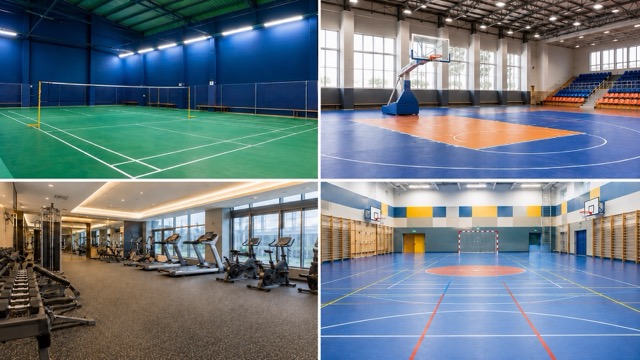
| Sports halls | PVC sports flooring |
Sheet vinyl is especially suitable for long school corridors because it reduces the number of joints and makes large areas easier to clean. PVC sports flooring is more suitable for gymnasiums because it provides shock absorption, comfort, and sports performance.
Best Vinyl Flooring for Offices
For offices, the most common choices are LVT, SPC, and heterogeneous vinyl flooring.
LVT and SPC are popular in reception areas, meeting rooms, and open offices because they offer wood, stone, and modern decorative designs. SPC provides good dimensional stability, while LVT offers flexible design options and a comfortable walking surface.
Heterogeneous PVC sheet flooring is suitable for large office corridors and shared areas that require fast installation, fewer joints, and easy daily maintenance.
Homogeneous vs. Heterogeneous Vinyl Flooring
| Feature | Homogeneous Vinyl Flooring | Heterogeneous Vinyl Flooring |
|---|---|---|
| Structure | Similar material from surface to bottom | Multi-layer structure |
| Main advantage | Strong durability and wear resistance | More colors and decorative designs |
| Typical applications | Hospitals and heavy-traffic areas | Hospitals, schools, offices, and commercial spaces |
| Hygiene performance | Excellent when installed as welded sheet flooring | Excellent when installed as welded sheet flooring |
For the best hygiene performance, both homogeneous PVC sheet flooring and heterogeneous PVC sheet flooring are suitable. Hygiene depends not only on the product structure, but also on the roll format, professional adhesive installation, heat-welded seams, and coved skirting.
Homogeneous vinyl is often selected for very heavy traffic. Heterogeneous vinyl is preferred when a project requires commercial performance together with more decorative options.
Key Factors When Choosing Commercial Vinyl Flooring
Hygiene
Hospitals and clean environments should use PVC sheet flooring with heat-welded seams. Vinyl tiles and planks have more joints, which may trap dirt or moisture if they are not properly maintained.
Traffic and Wear Resistance
Entrances, corridors, schools, hospitals, and public buildings need stronger flooring with better surface protection and higher wear resistance. Flooring for high-traffic areas should be selected according to the expected number of users, cleaning frequency, and movement of equipment or furniture.
Slip Resistance
Wet areas, cafeterias, entrances, healthcare corridors, and other public areas may require enhanced slip-resistant surfaces to improve safety.
Installation and Total Cost
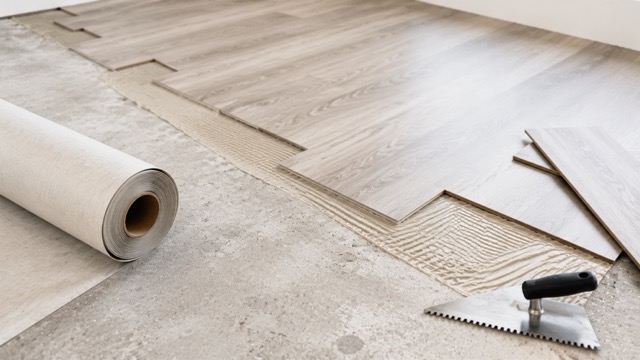
PVC sheet flooring is suitable for hygienic and large-area installation. LVT and SPC are useful when decorative design and individual plank replacement are more important. Buyers should compare product cost, installation cost, maintenance requirements, and expected service life.
Commercial Vinyl Flooring Compared with Other Materials
Compared with ceramic tile, commercial vinyl flooring is generally more comfortable underfoot, offers better slip-resistant options, and is more suitable for fast installation over large areas. It also creates less impact noise and provides a warmer walking surface.
Compared with carpet, vinyl flooring is easier to clean and better suited to healthcare and education areas. Compared with natural wood, it offers better moisture resistance and lower routine maintenance.
Frequently Asked Questions
What is the best flooring for hospitals?
Homogeneous or heterogeneous PVC sheet flooring is usually the best choice because heat-welded seams create a continuous, hygienic, and easy-to-clean surface.
What flooring should be used in operating rooms?
Operating rooms and other anti-static areas should use certified ESD, conductive, or static-dissipative PVC sheet flooring that meets the electrical resistance requirements of the project.
What flooring is best for high-traffic areas?
Heavy-duty homogeneous vinyl or commercial heterogeneous vinyl with strong surface protection and high wear resistance is suitable for high-traffic areas.
Is vinyl flooring suitable for schools and offices?
Yes. PVC sheet flooring is practical for corridors and public areas, while LVT and SPC are suitable for classrooms, libraries, meeting rooms, reception areas, and offices.
Conclusion
Hospitals and clean environments should prioritize homogeneous or heterogeneous PVC sheet flooring because heat-welded seams create a continuous surface that is easier to clean and less likely to trap dirt.
Operating rooms, laboratories, and anti-static areas should use certified ESD sheet flooring. Schools and other high-traffic spaces need stronger flooring with higher wear resistance. Offices can use LVT or SPC for decorative areas and heterogeneous sheet vinyl for large corridors and public spaces.
Choosing the correct flooring type, specification, slip resistance, and installation system improves hygiene, durability, safety, and long-term project value.