LVT vs SPC vs WPC: Which Flooring Is Best?
- 1
LVT vs SPC vs WPC Flooring: Quick Answer
LVT, SPC, and WPC are all popular vinyl flooring products, but they have different structures, installation methods, and recommended applications.
- LVT flooring is flexible, cost-effective, and available in glue-down, self-adhesive, loose lay, and click systems.
- SPC flooring has a dense rigid core that provides strong dimensional stability and good resistance to indentation.
- WPC flooring has a lighter and softer rigid core, providing better comfort, warmth, and sound absorption.
SPC is often selected for residential and normal commercial projects because it combines click installation, water-resistant materials, and dimensional stability. However, high-quality commercial LVT with a thick wear layer and professional installation may provide better wear performance than some standard or low-grade SPC products. WPC is mainly recommended for residential and hospitality spaces where comfort is a priority.
LVT vs SPC vs WPC Flooring Comparison
| Feature | LVT Flooring | SPC Flooring | WPC Flooring |
|---|---|---|---|
| Structure | Flexible vinyl | Dense rigid stone-plastic core | Lightweight rigid composite core |
| Installation | Glue-down, self-adhesive, loose lay, or click | Mainly click installation | Mainly click installation |
| Dimensional Stability | Medium | Excellent | Good |
| Walking Comfort | Good | Medium | Excellent |
| Subfloor Adaptability | Requires a flat and smooth subfloor | Thicker products tolerate minor irregularities better | Thicker products tolerate minor irregularities better |
| Typical Applications | Residential and commercial areas | Residential and commercial projects | Residential and hospitality spaces |
What Is LVT Flooring?
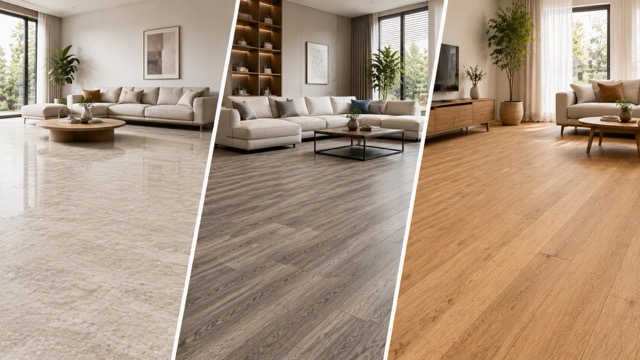
LVT stands for Luxury Vinyl Tile. It is a flexible vinyl flooring designed to reproduce the appearance of wood, stone, marble, and other natural materials.
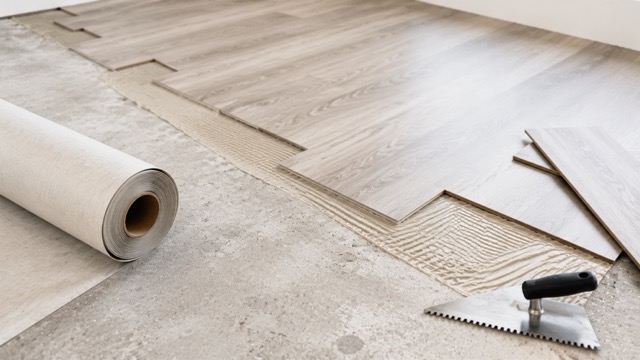
LVT is available in several installation formats, including glue-down LVT, self-adhesive LVT, loose lay LVT, and click LVT. Glue-down commercial LVT is widely used in offices, retail stores, hotels, apartments, and other large commercial spaces because it creates a stable floor with minimal movement when correctly installed.
The durability of LVT depends on the total thickness, wear layer, surface treatment, raw material quality, and installation method. High-quality commercial LVT with a 0.5 mm, 0.7 mm, or thicker wear layer may provide excellent resistance to abrasion and heavy foot traffic.
What Is SPC Flooring?
SPC stands for Stone Plastic Composite. It is a rigid core flooring made from PVC resin, limestone powder, stabilizers, and other materials.
The dense SPC core provides strong dimensional stability and good resistance to pressure and indentation. Most SPC flooring uses a click-lock installation system and may include an attached IXPE or EVA underlayment for better sound reduction and walking comfort.
SPC flooring is commonly used in apartments, rental properties, offices, retail stores, hotels, kitchens, corridors, and commercial renovation projects. It is especially suitable when fast floating installation and dimensional stability are important.
What Is WPC Flooring?
WPC stands for Wood Plastic Composite or Waterproof Polymer Core. Like SPC, it is a rigid vinyl flooring, but its core is generally lighter, thicker, and softer.
WPC provides a warmer and more comfortable walking feeling than dense SPC flooring. Its softer core and thicker structure also help reduce walking noise, making it suitable for bedrooms, living rooms, villas, hotels, guest rooms, and premium residential projects.
WPC is usually more expensive than standard LVT and SPC. It is mainly selected for comfort and sound absorption rather than maximum core density or resistance to concentrated loads.
Which Flooring Has Better Subfloor Adaptability?
All LVT, SPC, and WPC flooring requires a clean, dry, stable, and reasonably level subfloor. No flooring product should be used to cover serious cracks, deep depressions, loose concrete, or major unevenness.
Flexible glue-down LVT follows the shape of the subfloor closely. Surface defects, joints, and uneven areas may become visible after installation, so floor grinding, repair, or self-leveling treatment is often required.
SPC and WPC have rigid cores and can bridge minor subfloor irregularities better than thin flexible LVT. In general, the thicker the SPC or WPC flooring, the better it can adapt to small variations in the subfloor. A thicker rigid core combined with attached underlayment usually provides better adaptability than a thin rigid floor.
However, greater flooring thickness does not replace proper subfloor preparation. Serious unevenness can still damage the click system, create movement, or cause abnormal noise.
Which Flooring Is Better for Moisture-Prone Areas?
SPC and WPC cores do not absorb water easily, so they are suitable for kitchens, apartments, shops, and areas exposed to occasional moisture or regular cleaning.
For projects that experience humidity, temperature changes, or cleaning water, SPC is often a more stable choice because of its dense rigid core. However, SPC flooring is not suitable for continuous immersion or long-term standing water.
Water may enter through joints, perimeter gaps, expansion spaces, or damaged locking systems and affect the underlayment or subfloor. SPC should not be installed in areas that are regularly flooded or continuously soaked. Spilled or standing water should be removed promptly.
Is SPC Better Than LVT Flooring?
SPC is not automatically better than LVT. The correct choice depends on the flooring quality, installation environment, traffic level, and project requirements.
SPC generally provides better dimensional stability, easier floating installation, and greater tolerance of minor subfloor irregularities. It is a practical option for apartments, shops, offices, hotels, and renovation projects.
However, high-quality thick commercial LVT can provide better wear resistance than standard SPC flooring. A heavy-duty glue-down LVT with a thick wear layer, high-quality PUR surface treatment, and professional installation may perform extremely well in high-traffic commercial spaces.
The thickness of an SPC core should not be confused with surface wear resistance. Surface durability is mainly determined by the wear layer, surface coating, material quality, traffic type, and maintenance conditions.
Which Flooring Is Best for Commercial Projects?
SPC is a balanced option for offices, shops, apartments, hotels, and normal commercial projects because it offers fast click installation, good dimensional stability, and easy maintenance.
Commercial glue-down LVT may be more suitable for very large areas, heavy foot traffic, rolling loads, or projects requiring a low-profile floor without floating movement. WPC is more suitable for hotel rooms and comfort-focused spaces but is generally not the first choice for heavy rolling traffic or concentrated loads.
Final Recommendation
Choose LVT flooring when the project requires flexible installation options, competitive pricing, low floor height, or heavy-duty commercial wear performance.
Choose SPC flooring when the project requires strong dimensional stability, click installation, water-resistant materials, and reliable performance in residential or normal commercial areas.
Choose WPC flooring when walking comfort, warmth, and sound reduction are the main priorities.
The best flooring should not be selected by product name alone. Buyers should compare the total thickness, wear layer, core quality, surface treatment, locking system, installation method, subfloor condition, and expected traffic level.
Frequently Asked Questions
Can SPC flooring be installed on an uneven floor?
SPC can tolerate minor subfloor variations, especially when the flooring is thicker and includes attached underlayment. Serious cracks, depressions, and uneven areas must still be repaired before installation.
Can SPC flooring remain underwater?
No. The SPC material resists water, but the complete flooring system is not designed for continuous immersion or long-term standing water.
Can commercial LVT be more durable than SPC?
Yes. High-quality commercial LVT with a thick wear layer and durable surface treatment may provide better surface wear resistance than standard or low-grade SPC.
Which flooring is the most comfortable?
WPC is generally the most comfortable and quietest option. Flexible LVT also provides good walking comfort, while SPC feels harder because of its dense rigid core.
Which flooring is best for high-traffic areas?
Commercial glue-down LVT and high-quality SPC can both be suitable. The final choice should be based on the wear layer, surface treatment, installation method, rolling traffic, and maintenance requirements.